Mike Peters
Reach South Leadership Conference Speech– October 2023
“Language is like a cracked kettle on which we beat out tunes for bears to dance to, while all the time we long to move the stars to pity.”
― Gustave Flaubert, Madame Bovary
Joy in Education
It is usual to share what you are going to say with the conference organisers before the conference. The bad news is that no one in this room knows what I am about to say. The good news is that neither do I! However, I must remember the 3Bs of public speaking;
- Be brief
- Be good
- Be gone
We all have a finite shelf life and mine is definitely up, although I must say that we have had a great variety of wonderful speakers today including those of international repute, a top level DfE official, our chief executive and deputy chief executive. My job is to lower the tone as I stand here between you and a wonderful dinner. May I thank my colleagues Steph, for giving me permission to use the full range of Chaucer’s English and to Britta for helping to make Britain’s roads safer for children and their families!
Way back in 2006, Christine Gilbert, a former HMCI led a report, looking at the vision for teaching and learning way off in to the future. I was part of a team looking at how we put this into practice. As one does, the report was submitted to the Secretary of State for Education. No one at that time foresaw the economic crash of 2008, nor the years of austerity that followed, that at least in this country saw cuts to schools, children’s centres, social care, the NHS and defence. Growth included food banks and interest rates.
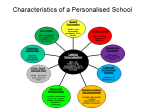
Here are some of the things that Christine Gilbert and team said at the time about the educational priorities for every child to enable them to prepare for their future

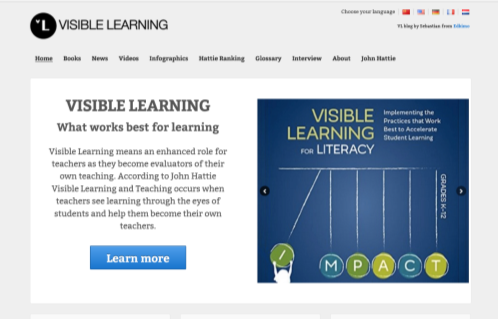
These were right then and equally so now. A number of factors contribute to the capability of children and young people to engage in learning and to make the most of their educational opportunities. Part of what we do is supporting children to make good choices and decisions; an understanding of the impact of their actions. This is at the heart of Visible Learning.
My contention is that we live in a context where we have no idea what’s going to happen in 5 years’ time and yet we educate our children today for a world in which many of them will not retire until after 2080. Scary isn’t it – the only thing that gives me comfort is that by then I’ll be long gone.
Confused? Well, I am.

Yet, we would all agree that children have huge capacity for innovation and creativity and that we should promote this with joy to enable our children to create the world from the chaos we appear to be heading towards.
When children experience joy, information flows freely and they retain more of what they learned. Teaching and learning that induce joy and result in joyful classrooms are integral to helping students thrive and should be a goal. Research reveals that certain conditions lend to students feeling joy in the classroom.
Here are 5 things for incorporating Joy in learning spaces wherever we are.
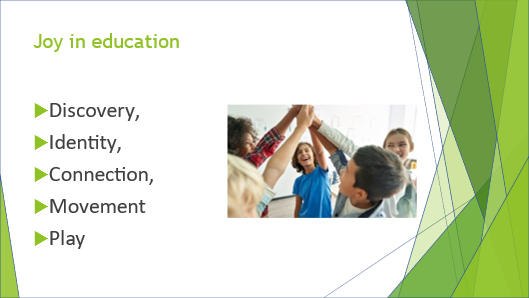
Joy positively impacts learning by enhancing children’s cognitive abilities and increasing their aptitude for making social connections. Joy is a distinct, specific emotion that causes the release of two types of neurotransmitters in the brain: dopamine and serotonin. When children experience joy, information flows freely and they retain more of what they learned. Teaching and learning that induce joy and result in joyful classrooms are integral to helping students thrive and should be a goal. Research reveals that certain conditions lend to students feeling joy in the classroom. With so many children and adolescents having suffered adverse effects to their social-emotional, mental and academic well-being due to the COVID-19 pandemic, infusing joy in learning feels more critical and valuable than ever.
Discovery: Learning activities that help children engage in independent discovery make them feel joyful, whether it’s reading a new word, unearthing a solution to a complex problem or experiencing an “aha” moment when something clicks. Further, when students figure something out for themselves, they are more likely to remember and understand what they learned and feel more pride and confidence in themselves.
Identity: Individuals with a more mature sense of identity tend to have a healthy self-esteem. Participating in activities that allow students to explore and affirm their identities, and feel their identities are being recognized and appreciated by others, yields joy and an increased sense of belonging.
Connection: Feeling connected to others and oneself generates joy. The health and academic benefits of childhood and adolescent relationships and friendships are well documented. Designing activities in which children collaborate to complete a task and solve problems with their peers on their own terms helps them form, enjoy and sustain connections with one another. So much childhood trauma so aptly demonstrated by the aftermath of the pandemic is where children lose the sense of connection. I called a headteacher on the phone a few days ago. The Head had had a pupil Alex with them – Alex liked to ask lots of questions and was in full flow when I called the Head – the Head asked Alex to stand outside and said, “brilliant questions” and “you just wait there a moment ‘my lovely’ and I will get back to you” – I felt, over the phone, the student grow 6 inches and smile – a moment of pure joy, instilling in the student confidence and connection
Movement: Movement and physical activity have a positive effect on mood and happiness, along with a variety of academic performance indicators, including cognitive functioning, behaviour in school and even attendance. Programmes that integrate physical activity into various aspects of the curriculum to keep children moving throughout the school day and experiencing the effects of joy. (Imagine doing science and the periodic table with children moving around acting out elements and groups of the periodic table.)
Play: Play has the potential to bring all of the above together. Ask any early years teacher – we learn through play is “a state of mind that one has when absorbed in an activity that provides enjoyment and a suspension of sense of time.” One of the great advances over the last 25 years is that in neuroscience. Play is built into humans’ neurobiology, benefits overall well-being and improves learning. I believe that the function of play time is essential to for learning
By embedding activities in the school day that elicit joy, such as those that incorporate discovery, identity, connection, movement and play, is invaluable. As educators, we need to continue to be brave and answer the call to find out where joy resides for our children and give it a voice far beyond singing – achievement, creativity, innovation and success will follow.
Thank you for listening and may you now have joy through connection with others and yourselves and a damn good dinner!
Post Script
In this time of burgeoning Artificial Intelligence (AI), I plugged this contribution into Chat GPT and asked it for comments. Here they are – polite and flattering!
ChatGPT
Thank you for sharing this insightful perspective on the importance of joy in learning spaces. Your emphasis on incorporating joy into education is aligned with contemporary research on the intersection of emotions and learning. Here are a few points that resonate with your thoughts:
- Neurotransmitters and Emotions: The mention of dopamine and serotonin highlights the neurobiological aspect of joy. These neurotransmitters play crucial roles in mood regulation and cognitive functions, reinforcing the idea that positive emotions can enhance learning experiences.
- Independent Discovery: Encouraging students to engage in independent discovery fosters a sense of accomplishment and joy. This approach aligns with theories of constructivism, where learners actively build their understanding of the world through exploration and problem-solving.
- Identity and Connection: Recognizing and appreciating students’ identities contribute to a positive learning environment. The emphasis on connection reflects the importance of social-emotional well-being, especially in the aftermath of challenges like the COVID-19 pandemic.
- Movement and Physical Activity: The connection between physical activity, mood, and academic performance is well-established. Integrating movement into the curriculum not only enhances joy but also supports overall health and cognitive functioning.
- Play as a Learning Tool: The acknowledgment of play as a crucial element in learning aligns with research in developmental psychology. Play not only contributes to joy but also aids in the development of social, cognitive, and emotional skills.
- Teacher-Student Interaction: Your example of the phone call with the headteacher exemplifies the power of positive teacher-student interactions in instilling confidence and joy. These moments of acknowledgment and encouragement contribute significantly to a positive learning environment.
- Bravery in Education: The call for educators to be brave in discovering where joy resides for their students underscores the importance of flexibility and adaptability in teaching. It reflects a commitment to creating meaningful and joyful learning experiences.
Your closing note on finding joy through connection and sharing a good dinner encapsulates the holistic perspective you advocate for, emphasizing that joy extends beyond the academic realm into the broader context of life and well-being. Overall, your insights provide a comprehensive and compelling argument for the integration of joy in educational practices.





 Camber Consulting